← Back to blog # How to Use the Apify MCP in Claude Code to Search for CENDOJ Judgments
Learn how to connect the Apify MCP to Claude Code and use the legaltech/cendoj actor to search and analyse CENDOJ judgments directly from the chat, simply by asking in natural language.
Searching for case law in CENDOJ and applying filters by court, subject, or date can take a lot of time. In this guide you will learn how to connect the **Apify MCP** to **Claude Code** so that the assistant itself searches for judgments on your behalf and presents them ready for analysis, all from a simple conversation.
## 🤖 Tutorial: Use the Apify MCP in Claude Code to Search for CENDOJ Judgments
Thanks to the **Model Context Protocol (MCP)**, Claude Code can connect to external tools such as Apify. This means that, instead of manually navigating and filtering the CENDOJ search engine, you can ask Claude in natural language to retrieve the judgments you need and work with them.
In this case we will use the [`legaltech/cendoj`](https://apify.com/legaltech/cendoj?fpr=legaltech) actor, which searches for judgments published in CENDOJ and lets you filter them — for example, by **subject** and **court**.
### **Step 1: Create an Apify Account**
The first thing you need is an Apify account. If you do not have one yet, sign up using the button below. The free plan is sufficient, as it provides monthly usage credits to run the actor.
<br>
<a href="https://console.apify.com/sign-up?fpr=legaltech" target="_blank" rel="noopener noreferrer" style="display: inline-block; padding: 10px 20px; font-size: 16px; font-weight: bold; text-align: center; text-decoration: none; color: #ffffff; background-color: #6B46C1; border-radius: 8px;">
Create a free Apify account
</a>
<br>
### **Step 2: Get Your Apify Personal API Token**
For Claude Code to authenticate with Apify, you need to generate a personal API token.
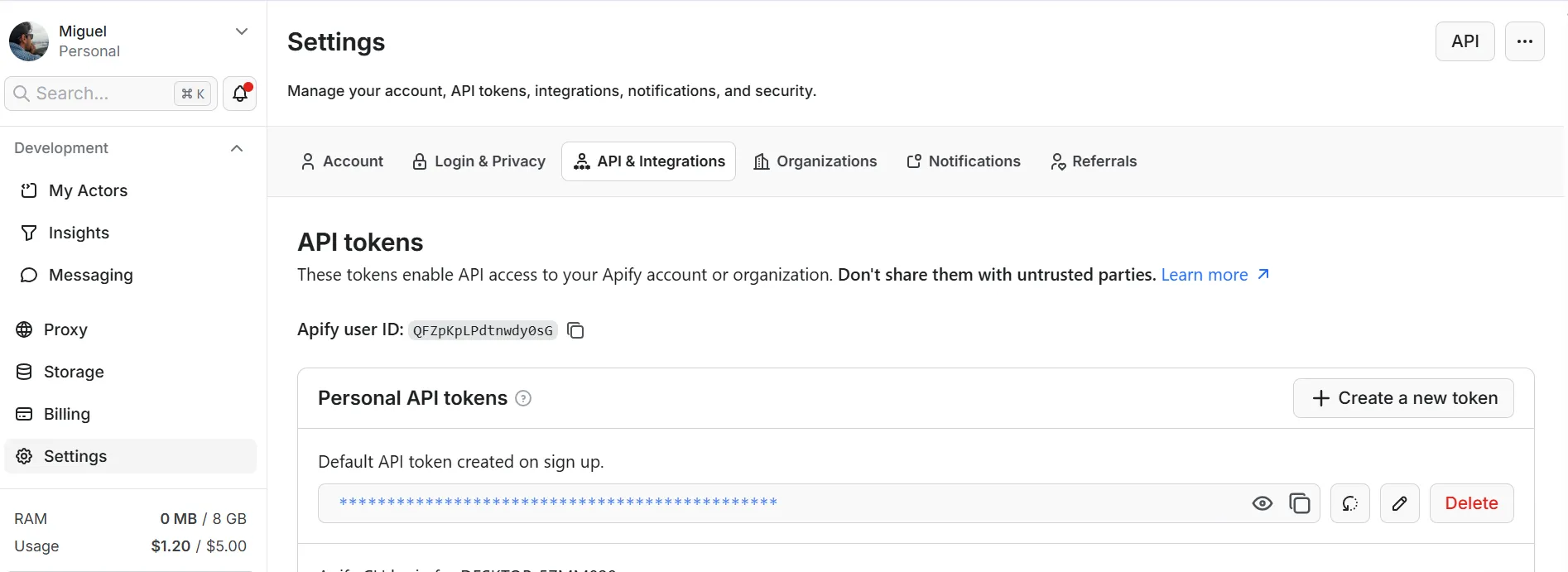
1. Log in to your Apify account and go to **Settings → API & Integrations**.
2. Click **Create new token**, give it a descriptive name, and copy it.

Keep that token handy: you will need it in the next step when adding the connector in Claude Code.
### **Step 3: Set Up Apify in Claude Code**
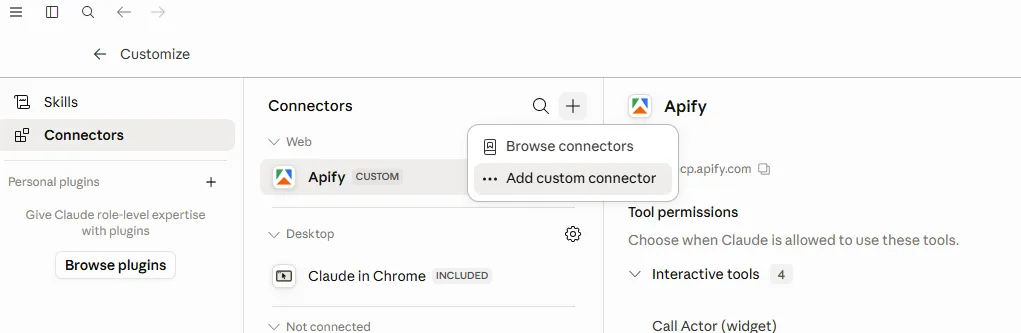
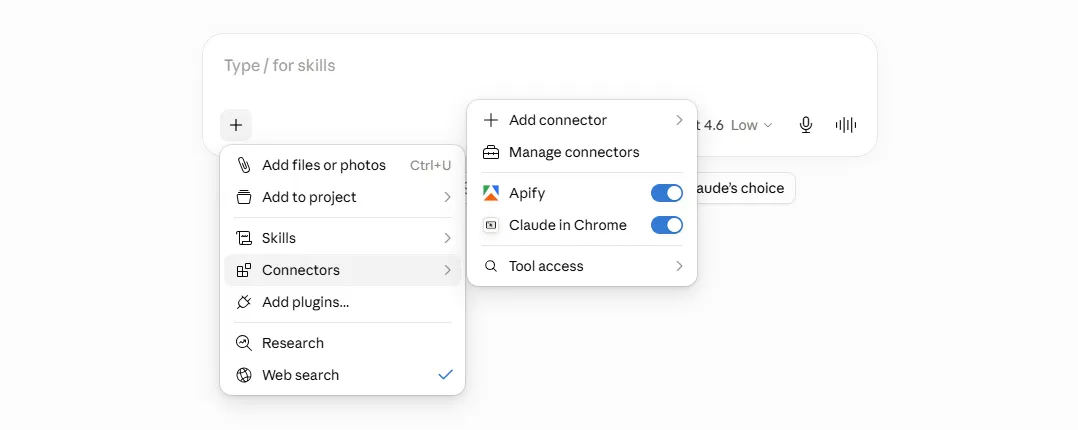
For Claude Code to communicate with Apify, you need to add the Apify MCP **custom connector**.
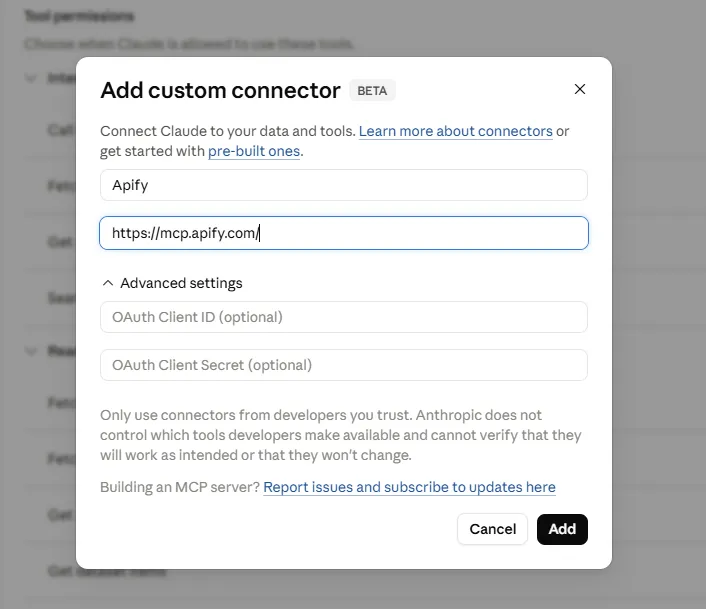
1. Go to Claude's connector settings and select **Add custom connector**.

2. Enter the Apify MCP details to complete the connection.

https://mcp.apify.com/?tools=actors,docs,runs,storage,tasks,legaltech/cendoj,legaltech/hacienda,legaltech/tribunal-constitucional,legaltech/tjue,legaltech/fiscalia,legaltech/catastro,legaltech/ine,legaltech/aepd

### **Step 4: Check That Apify Is Available in the Chat**
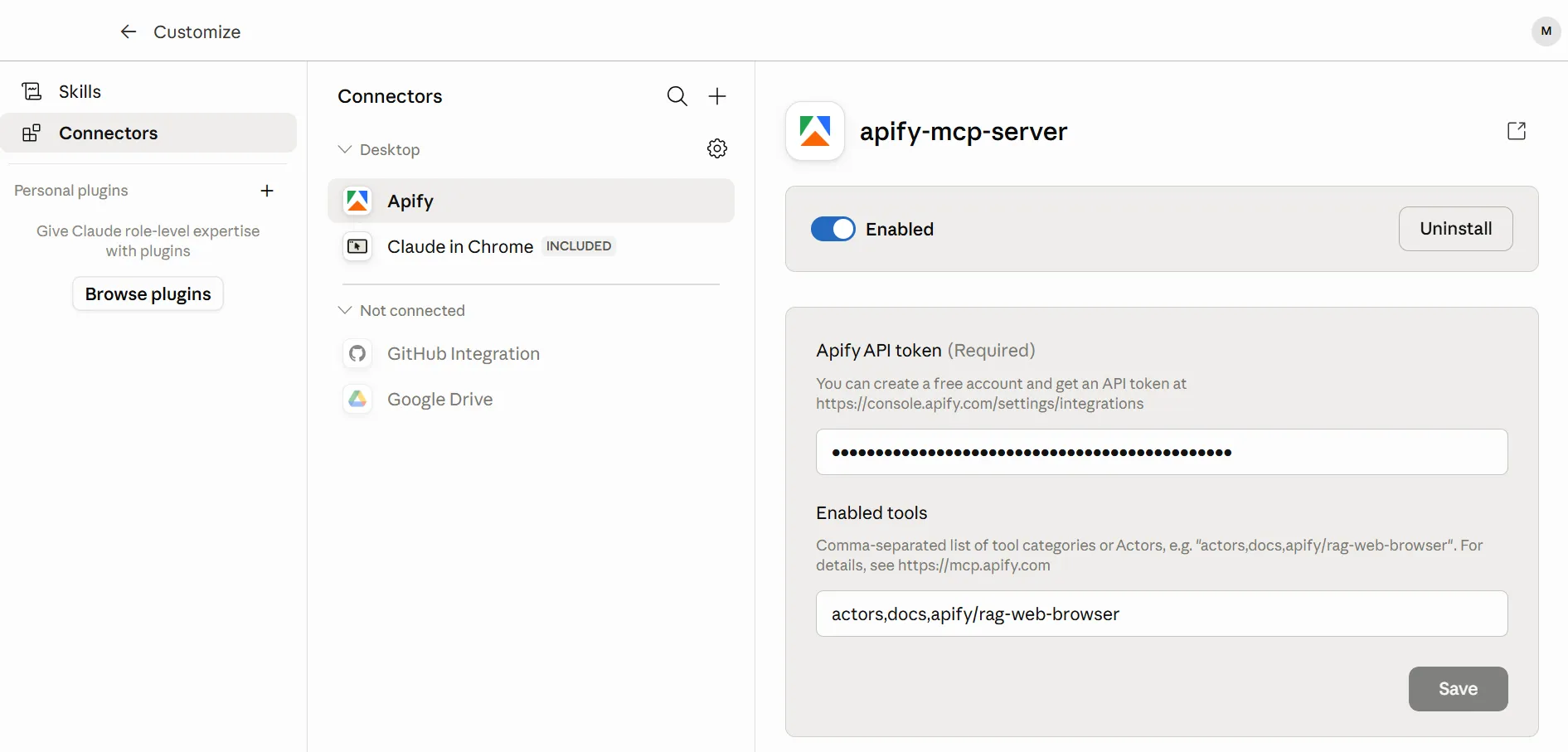
Once the connector is configured, open the Claude chat and verify that Apify appears as an available tool. From this point on, Claude can run Apify actors for you.

### **Step 5: Ask Claude for the Judgments You Need**
Now for the interesting part. With the [`legaltech/cendoj`](https://apify.com/legaltech/cendoj?fpr=legaltech) actor connected, you no longer need to worry about filters or forms — just tell Claude in natural language what case law you are looking for.
For example, type directly in the chat:
> **Use the legaltech/cendoj actor and give me the latest judgments on mortgage costs published in CENDOJ handed down by the Supreme Court**
Claude will run the actor with the criteria you specified (subject *mortgage costs* and court *Supreme Court*) and return the list of CENDOJ judgments that match your request.
### **Step 6: Analyse the Judgments from the Chat**
Once Claude has the judgments in front of it, you can keep working with them without leaving the conversation. Just ask whatever you need in natural language, for example:
- *Summarise the facts and ruling of each judgment.*
- *What position does the Supreme Court take on the allocation of mortgage costs?*
- *Sort them by date and tell me which three are the most recent.*
- *Identify whether there has been any change of criteria between the oldest and the newest judgments.*
- *Generate a table with the date, judgment number, and a one-sentence summary of the ruling.*
From that point on, the analysis is a conversation: you refine your questions and Claude responds drawing on the judgments it retrieved from CENDOJ, saving you the initial search and reading time.
Published on Thu Jun 18 2026 00:00:00 GMT+0000 (Coordinated Universal Time) by Miguel Gonzalez Herrera
Searching for case law in CENDOJ and applying filters by court, subject, or date can take a lot of time. In this guide you will learn how to connect the Apify MCP to Claude Code so that the assistant itself searches for judgments on your behalf and presents them ready for analysis, all from a simple conversation.
🤖 Tutorial: Use the Apify MCP in Claude Code to Search for CENDOJ Judgments
Thanks to the Model Context Protocol (MCP), Claude Code can connect to external tools such as Apify. This means that, instead of manually navigating and filtering the CENDOJ search engine, you can ask Claude in natural language to retrieve the judgments you need and work with them.
In this case we will use the legaltech/cendoj actor, which searches for judgments published in CENDOJ and lets you filter them — for example, by subject and court.
Step 1: Create an Apify Account
The first thing you need is an Apify account. If you do not have one yet, sign up using the button below. The free plan is sufficient, as it provides monthly usage credits to run the actor.
Once the connector is configured, open the Claude chat and verify that Apify appears as an available tool. From this point on, Claude can run Apify actors for you.
Step 5: Ask Claude for the Judgments You Need
Now for the interesting part. With the legaltech/cendoj actor connected, you no longer need to worry about filters or forms — just tell Claude in natural language what case law you are looking for.
For example, type directly in the chat:
Use the legaltech/cendoj actor and give me the latest judgments on mortgage costs published in CENDOJ handed down by the Supreme Court
Claude will run the actor with the criteria you specified (subject mortgage costs and court Supreme Court) and return the list of CENDOJ judgments that match your request.
Step 6: Analyse the Judgments from the Chat
Once Claude has the judgments in front of it, you can keep working with them without leaving the conversation. Just ask whatever you need in natural language, for example:
Summarise the facts and ruling of each judgment.
What position does the Supreme Court take on the allocation of mortgage costs?
Sort them by date and tell me which three are the most recent.
Identify whether there has been any change of criteria between the oldest and the newest judgments.
Generate a table with the date, judgment number, and a one-sentence summary of the ruling.
From that point on, the analysis is a conversation: you refine your questions and Claude responds drawing on the judgments it retrieved from CENDOJ, saving you the initial search and reading time.
How to Use the Apify MCP with a Local Model (Ollama) to Search CENDOJ Rulings
Learn how to search Spanish CENDOJ rulings in natural language with a language model that runs on your own computer: Ollama, AnythingLLM and the Apify MCP, without sending your conversations or documents to Claude or ChatGPT.
How to Use the Apify MCP in Claude to Find Which Cadastral Parcel You Are In and Look Up Its Data
Learn how to connect the Apify MCP to Claude and use the legaltech/catastro actor to get a parcel's cadastral reference from your coordinates or an address, and look up its official data without going through the Spanish Cadastre website.
How to Use the Apify MCP in Claude to Cross-Reference Spanish Mortgage and Foreclosure Data from the INE
Learn how to connect the Apify MCP to Claude and use the legaltech/ine actor to cross-reference Spain’s Mortgage Statistics and Mortgage Foreclosure Statistics from the INE, and reach the provincial figure no article publishes.
How to Use the Apify MCP in ChatGPT to Access LegalTech Legal Connectors
Learn how to use LegalTech legal connectors from a free ChatGPT account: enable Developer Mode, add the Apify MCP (@Apify), and query Fiscalía, CENDOJ, Hacienda, Property Registry, and more directly from the chat.
How to Use the Apify MCP in Claude to Query Doctrine from the Spanish State Prosecutor Office
Learn how to connect the Apify MCP to Claude and use the legaltech/fiscalia actor to search Circulares, Instrucciones and Consultas from the Spanish State Prosecutor Office directly from the chat, simply by asking in natural language.
How to Use the Apify MCP in Claude to Query Spanish Tax Authority Administrative Doctrine
Learn how to connect the Apify MCP to Claude and use the legaltech/hacienda actor to query TEAC tax administrative doctrine, DGT binding rulings, and historical resolutions directly from the chat.
We use Google Analytics cookies to analyze traffic and improve your experience. You can accept them, reject them, or read our Privacy & Cookies policy. Privacy & Cookies.